- You have no items in your shopping cart
- Subtotal: BDT0.00
The Nakshi Kantha Handicraft of Jamalpur: Story & Care
Rooted in the riverbank courtyards of northern Bangladesh, Jamalpur’s embroidered quilts transform humble cotton into layered narrative art. This guide explores the heritage, intricate stitches, and essential care methods for genuine GI-certified pieces.

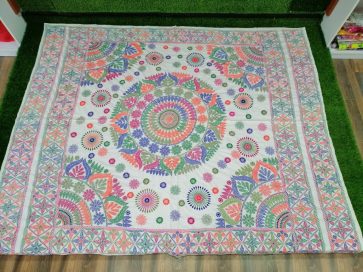
A slender steel needle pierces four layers of washed white cotton, pulling through a strand of indigo-dyed thread with a rhythmic hiss. In the shaded courtyard of a village home near the Brahmaputra River, an artisan secures the boundary line of a blooming lotus medallion before moving outward in close, rippling waves. This meticulous needlework defines the nakshi kantha handicraft of Jamalpur, an ancient folk textile tradition from northern Bangladesh where layered fabric becomes an expressive canvas of rural memory, folklore, and domestic life.
To understand nakshi kantha, one must first look at its name. Kantha refers to a quilt or layered cloth fashioned to provide light warmth, while nakshi comes from the Persian-derived Bangla word naksha, meaning artistic pattern or ornamental design. While kantha stitching exists across the Bengal delta, Jamalpur has long been celebrated as the spiritual and technical heartland of the craft. Here, women pass motifs down across generations, turning quiet afternoon hours between household responsibilities into enduring works of embroidered art.
The Riverine Rhythm of Jamalpur’s Needlework
Jamalpur sits along the alluvial floodplains of the Old Brahmaputra. The district’s climate and rural cadence have directly shaped how and when these textiles are born. During the heavy monsoon months, when fields are flooded and outdoor agricultural tasks slow down, women gather under tin-roof verandas to prepare quilt layers. In the dry, sunlit winter months, embroidery continues in open courtyards where natural daylight reveals the finest shifts in stitch tension.
Unlike commercial factory textiles produced on mechanical looms, a traditional Jamalpur quilt is an unhurried creation. A single bedspread-sized piece often requires between 150 and 300 hours of continuous hand-stitching over several months. The process begins not with embroidery, but with careful fabric selection. Artisans layer multiple sheets of high-grade, breathable cotton sheeting or repurposed soft cotton drapes, smoothing out every bubble by hand before basting the edges with long, loose holding stitches.
Anatomy of a Stitch: Texture, Tension, and Warmth
The beauty of a Jamalpur kantha lies in its tactile surface. When thread is pulled through multiple layers of cotton cloth, it creates a subtle puckering known locally as khesh. This puckered texture does more than create visual shadow lines; it traps air between the fabric plies, creating lightweight, breathable thermal insulation that makes the quilt suitable for mild winters, air-conditioned bedrooms, and cool summer evenings.
Master needleworkers in Jamalpur employ a sophisticated vocabulary of stitches to build tone and structure:
- Run Stitch (Soja Kantha): The foundational running stitch that forms background ripples and outlines main motifs. Spaced barely two millimeters apart, these parallel lines create the quilt’s structural strength.
- Bhorat Stitch: A dense satin-style filling stitch used to give solid color and raised texture to petals, bird feathers, and geometric borders.
- Terchi Stitch: A diagonal running stitch that catches light differently than horizontal lines, lending subtle shading to leaves and vines.
- Chokh Stitch: A diamond-shaped eyelet pattern often stitched along borders to ward off ill fortune and frame the inner narrative.
Motifs and Cultural Language of the Nakshi Kantha Handicraft of Jamalpur
Every traditional kantha acts as a silent journal. The women of Jamalpur do not sketch rigid grids onto their cloth with stencils; instead, experienced artisans trace ancestral forms freehand or work directly from memory. The motifs woven into the nakshi kantha handicraft of Jamalpur reflect both the natural world and spiritual concepts native to rural Bengal.
At the center of almost every large quilt sits the Padma (lotus medallion). In Bengali cosmology, the lotus represents purity, beauty, and renewal rising above muddy river waters. Radiating outward from the center, one frequently finds the Kalka—a teardrop-shaped paisley or mango motif representing fertility and prosperity. Bordering these focal points are running vines (lota pata), pairs of river fish (machh) symbolizing abundance, and representations of the Kadam flower and betel leaves (paan pata).
“A needle in an artisan’s hand is not simply a sewing tool; it is a pen writing down what the village sees, fears, and loves onto cloth that outlasts its maker.”
Geographical Indication (GI) and the Direct Artisan Model
The distinct regional identity, specialized stitching traditions, and generational heritage of Jamalpur’s needlecraft led to its formal recognition with Geographical Indication (GI) status in Bangladesh. This certification acknowledges that genuine Jamalpur kantha possesses unique characteristics tied directly to the geography, skill, and cultural heritage of this specific district.
For decades, traditional needleworkers faced exploitation from multiple layers of urban brokers and middle-tier wholesalers who purchased finished quilts at nominal rates while selling them at high margins in metropolitan showrooms. Direct sourcing models alter this balance fundamentally. When an artisan ships directly from her home to the collector, the fair value of her time and creative labor remains in her hands. This economic independence allows women to invest in family education, healthcare, and high-tensile embroidery threads without compromising their craft.
How to Identify Authentic Jamalpur Kantha
Because machine-embroidered imitations and chemically printed replicas flood commercial markets, discerning collectors should evaluate four specific physical markers before purchasing:
| Quality Marker | Authentic Jamalpur Hand-Stitched | Machine-Made Imitation |
|---|---|---|
| Stitch Irregularity | Subtle, organic variations in stitch length showing human hand movement. | Uniform, rigid lines with identical micro-spacing across the entire surface. |
| Reverse Side | Clean, tidy thread ties and continuous mirrored stitch paths on the back layer. | Messy web of tangled bobbin threads or stiff backing stabilizer paper. |
| Fabric Drape | Soft, supple, and naturally crinkled with immediate flexibility. | Stiff and flat due to machine tension and chemical sizing agents. |
| Thread Material | 100% natural cotton or silk embroidery thread that ages softly. | Shiny synthetic polyester threads prone to static and melting under heat. |
Caring for Your Heirloom Kantha
A genuine hand-embroidered kantha can endure for decades if treated with appropriate textile care. Because natural dyed threads and pure cotton fabrics require gentle handling, follow these foundational maintenance practices:
Washing Instructions
Always hand wash your quilt in cold water using a mild, pH-neutral liquid detergent formulated for delicate textiles or baby clothes. Avoid harsh chemical detergents, bleach, or optical brighteners that can strip vegetable and fiber-reactive dyes. Do not wring or twist the wet quilt, as the tension can snap delicate filling stitches.
Drying and Ironing
Gently press excess water out between clean, dry towels. Lay the kantha flat on a clean surface or drying rack in open shade. Direct, harsh sunlight should be avoided during drying to prevent color fading. If pressing is necessary, iron on the reverse side using a low-to-medium cotton setting with light steam, placing a thin pressing cloth over the embroidery to protect raised thread ridges.
Seasonal Storage
When storing your kantha between seasons, avoid airtight plastic bins which trap humidity and invite mold. Fold the quilt loosely inside a breathable, unbleached cotton storage bag. Every few months, unfold and air out the textile in a dry, shaded room to allow the natural cotton fibers to breathe.
Frequently asked questions
What makes the nakshi kantha handicraft of Jamalpur unique?
Jamalpur's nakshi kantha is distinguished by its dense running stitch work, complex botanical motifs, and Geographical Indication (GI) status. Artisans layer multiple cotton fabrics and hand-stitch intricate lotus, vine, and village patterns that create a distinctive, breathable puckered texture not found in machine-made quilts.
How do you distinguish a genuine handmade nakshi kantha from a machine copy?
Examine the reverse side and stitch variations. Authentic hand-stitched kantha shows slight, organic variations in stitch length, tidy handmade knots, and a supple drape. Machine-made versions feature rigid, hyper-uniform stitches, stiff fabric stabilizers, and tangled synthetic threads on the underside.
Can I wash my Jamalpur nakshi kantha in a washing machine?
Machine washing is not recommended. The mechanical agitation and spin cycle can pull or break delicate hand-embroidered threads. Instead, submerge the quilt in cold water with mild liquid detergent, gently press out excess water without wringing, and lay it flat to dry in the shade.